

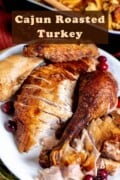
A good, Cajun roasted turkey is full of flavor and isn’t a hot and spicy affair. With crispy skin and succulent meat, this Cajun roasted turkey has a smoky, herbal, and peppery heat that keeps you coming back for seconds.
Growing up eating real Cajun food, I always get annoyed when restaurants or companies tout a “Cajun” dish that’s nothing but hot spices that overpower whatever they’re selling. Cajun food has a kick and a bite to it, but the flavors are well-rounded and deep and far from one-noted.
This Cajun roasted turkey recipe is an easy way to bring those deep and subtle flavors to your dining room. Making this roasted turkey for Thanksgiving can be a crowning center piece for a Cajun or Creole themed Thanksgiving spread that will impress family and friends alike.
Read through the entire post for tips about baking turkeys in general, as well as a list of ideas for great Thanksgiving sides. While you’re planning a menu that complements your turkey, don’t forget to check out my Fall and Thanksgiving categories for some great desserts also.

Jump to:
- 🧂 Cajun vs Creole Seasoning
- 🥘 Ingredients for Cajun Roasted Turkey
- 🔪 How to Make Cajun Roasted Turkey
- 📜 USDA Thawing & Cooking Guidelines
- 🦃 General Oven Roasted Turkey Tips
- 🍽 Recommend Equipment
- 🥗 What to Serve with Cajun Roasted Turkey
- 🍗 Thanksgiving Leftovers
- ❄️ How to Store & Reheat Cajun Roasted Turkey
- 📋 Recipe
- 💬 Comments
🧂 Cajun vs Creole Seasoning
While the terms are often used interchangeably, they actually do have subtle differences. Commercial blends available at most grocery stores don’t really do anything to dispel the notion either. Even the most well-known brands might be labeled Cajun on one and Creole on another but have almost identical ingredients.
Cajun seasoning is spicier and has a more pepper-forward flavoring. It is typically made from a blend of black and white pepper, garlic and onion powder, cayenne, and paprika.
On the other hand, Creole seasoning tends to be milder, with an herbal flavor. This makes it more popular with people that need a less spicy seasoning blend in dishes. Creole seasoning is usually a blend of things like paprika, black pepper, garlic and onion powder, and dried thyme, basil, and oregano.
As far as I know, there’s no hard and fast rules about these seasoning blends. If there’s a commercially made one that you prefer, feel free to use them. Tony Chachere’s, Slap Ya Mama, and Zatarain’s all make great options.
🥘 Ingredients for Cajun Roasted Turkey
I try to keep this recipe simple and easy. For the most part, it’s just the turkey with butter and seasoning. While not pictured, use the list of veggies for added flavor, especially if you plan to make gravy from the turkey drippings.

Turkey – As written, this recipe assumes a turkey in the range of 12-14 pounds. Anything above 9-10 pounds shouldn’t require any changes, but if you start getting bigger than 15 pounds, I suggest increasing or doubling the amount of butter and seasoning called for.
Butter – Use about 12 tablespoons (1 ½ sticks) of butter here, salted or unsalted is fine. It needs to be softened, not just room temperature, but malleable.
Seasoning – As mentioned above in Cajun vs Creole seasoning, you can use a brand name seasoning if you keep one on hand that you like. The seasoning I use here is a mix between them and includes black and white pepper, garlic and onion powder, smoked paprika and cayenne, and dried thyme and oregano.
Optional
Not required, but adds a nice, subtle flavor. If making gravy from the drippings, then I suggest using these ingredients.
Vegetables – A mixture of rough chopped onions, celery, and green bell peppers. This is known as the “holy trinity” in Cajun cooking and will add a bit of flavor to the turkey and the gravy. Roughly chop them and add some to the turkey cavity and the rest below the turkey in the roasting pan.
Fruit – If you want, add a bit of citrus to the vegetable mix. I like orange here; it seems to complement the Cajun flavors. Lemon is also acceptable.
Liquid Injectors – I don’t use these here so that it keeps the recipe simple and the costs down. If you like using them though, feel free to add them. Tony Chachere’s makes a good creole butter version, or a roasted garlic and herb injectable. Depending on the size of your turkey, you may need at least 2 of these.
Alternatively, you can use an empty flavor injector and double the butter and seasoning recipe above. Split that in half and melt half of it to fill your own injector.
🔪 How to Make Cajun Roasted Turkey
Once your turkey has thawed completely, open it and detach any plastic pieces and from the cavity remove the neck and any bags containing the liver and giblets, etc. I like saving the neck to make homemade turkey stock, but you can also save that and any of the organs from the bag to make gravy if you like. Keep those pieces refrigerated.
Set the turkey on a rack set in a baking sheet and use paper towels to dry the outside of the bird as well as you can. Use some more to clean and dry the cavity as well. Gently separate the skin from the meat as best you can without tearing it. Liberally apply the kosher salt to the inside and outside of the turkey, as well as under the skin.
Preheat your oven to 425°F / 220°C and move the oven rack to the lower part of the oven. Depending on the size of your turkey, the middle of the bird should be roughly in the middle of the oven. Leave the salted turkey sitting at room temperature for an hour before cooking. While it sits, prepare the seasoned butter.

In a small bowl, add all the seasonings and mix. In another bowl, add the softened butter and make sure it’s soft enough to smash down. Add the seasoning blend over the butter and smash and mix them until you have a compound butter.
After the hour has elapsed, spread the seasoned butter all over the turkey. Be sure to get inside the cavity and under the skin again. If using the optional ingredients, chop them coarsely and stuff them inside the turkey cavity and add the rest to the bottom of the roasting pan. Tie the legs together if you like and cover or tuck the wing ends under the turkey.

Move the turkey to the rack from the roasting pan, breast side up, and place into the roasting pan. Place in the oven, legs towards the back if you can.
Roast the turkey for 30 minutes, then turn the heat down to 325°F / 160°C. If at any point the vegetables on the bottom look too dry or dark from a lack of drippings, add 1-2 cups of water or chicken/turkey stock. If the turkey seems to be browning too fast for you, tent it with some foil. It should be a dark, golden brown at the end.
Baking times can vary a lot, so never rely on timers. A rough gauging of 13-18 minutes per pound is a good estimate, but always use a quality instant-read thermometer to check doneness. The breasts should register around 155-160°F and the thighs about 165-170°F. After removing from the oven, carry-over cooking will finish heating it the rest of the way.

When finished cooking, remove the roasting pan from the oven. Move the turkey to a clean baking sheet with a rack set inside. Tent the turkey with foil and allow it to rest at least 35-45 minutes before slicing into it.
📜 USDA Thawing & Cooking Guidelines
Thawing Frozen Turkeys
In the Refrigerator (40°F or below)
Allow approximately 24 hours for every 4 to 5 pounds
| 4 to 12 pounds | 1 to 3 days |
| 12 to 16 pounds | 3 to 4 days |
| 16 to 20 pounds | 4 to 5 days |
| 20 to 24 pounds | 5 to 6 days |
Keep the turkey in its original wrapper. Place it on a tray or in a pan to catch any juices that may leak. A thawed turkey can remain in the refrigerator for 1 to 2 days. If necessary, a turkey that has been properly thawed in the refrigerator may be refrozen.
In Cold Water
Allow approximately 30 minutes per pound
| 4 to 12 pounds | 2 to 6 hours |
| 12 to 16 pounds | 6 to 8 hours |
| 16 to 20 pounds | 8 to 10 hours |
| 20 to 24 pounds | 10 to 12 hours |
Wrap your turkey securely, making sure the water is not able to leak through the wrapping. Submerge your wrapped turkey in cold tap water. Change the water every 30 minutes. Cook the turkey immediately after it is thawed. Do not refreeze.
Approximate Times for Oven Roasting
(325°F oven temperature)
Use the timetables below to determine how long to cook your turkey. These times are approximate. Always use a food thermometer to check the internal temperature of your turkey and stuffing.
Unstuffed
| 4 to 8 pounds (breast) | 1½ to 3¼ hours |
| 8 to 12 pounds | 2¾ to 3 hours |
| 12 to 14 pounds | 3 to 3¾ hours |
| 14 to 18 pounds | 3¾ to 4¼ hours |
| 18 to 20 pounds | 4¼ to 4½ hours |
| 20 to 24 pounds | 4½ to 5 hours |
Stuffed
| 4 to 6 pounds (breast) | Not usually applicable |
| 6 to 8 pounds (breast) | 2½ to 3½ hours |
| 8 to 12 pounds | 3 to 3½ hours |
| 12 to 14 pounds | 3½ to 4 hours |
| 14 to 18 pounds | 4 to 4¼ hours |
| 18 to 20 pounds | 4¼ to 4¾ hours |
| 20 to 24 pounds | 4¾ to 5¼ hours |
Personal Advice
Cooking times can vary a lot, especially with two different temperatures. An overly general approximation can vary from 13-18 minutes per pound. I would use a general time of 12-13 minutes per pound to guess when to start checking the temperature of your turkey. It probably won’t be done, but this gives you a good time to start checking instead of opening and closing the oven every 20 minutes.
Always, always rely on a quality instant-read thermometer instead of timetables. Approximate times are great for giving you an idea of how much time to set aside and can help you gauge when to start the cooking if you want to eat at a certain time. However, always confirm the doneness with a thermometer. Waiting for the turkey to rest and then carving it in front of your family isn’t the time to find out that it’s still raw in places.
When checking the temperature, stick the probe of your thermometer in the deepest parts of the breasts, and then check the fat part of drumsticks and thicker parts of the thigh. Try to avoid hitting the bones. If you cook your turkey with stuffing, check that it is cooked to 165°F as well.

🦃 General Oven Roasted Turkey Tips
Buying & Serving Tips
How much turkey?
A good rule of thumb is to plan for 1-1 ¼ pounds per person. Most people aren’t going to actually eat an entire pound of turkey meat, but you’re accounting for the bones and cartilage and other parts that aren’t going to be eaten.
When to buy?
If purchasing a fresh turkey, don’t buy more than 1-2 days ahead of time. Frozen turkeys will need an average of 24 hours per 5 pounds to thaw, so plan ahead. I like to start looking for turkeys 1-3 weeks before Thanksgiving, as that is when you start seeing sales between $0.79 - 0.99/pound.
Serving a small crowd.
Personally, I still like to buy a 10-12lb turkey for a small crowd, because I like making creative leftovers. If you get a good price on a whole turkey, it can also end up cheaper than buying a turkey breast instead.
If the price doesn’t make a big difference to you, then turkey breasts are a good option for a smaller group though. They cook faster and are easier to handle, but you’re also limited to all white meat. Another good option to consider are Cornish hens. Those actually make a nice meal, and you can buy and cook 1 hen for every 1-2 people.
Serving a large crowd.
Trying to find a roasting pan large enough to accommodate a 20-25lb turkey and getting it to cook evenly can be daunting. I’m not a fan of roasting turkeys of that size. They’re difficult to cook evenly, take a long time to bake, and you’re much more likely to dry it out unintentionally.
If you’re serving a huge crowd, there’s two options I suggest. Buy two smaller turkeys and you can spatchcock them. This will allow you to cook them at the same time. Another option is to use a large bird, or two smaller ones, and break them down before cooking. Roasting the turkey in pieces will keep them moist and they cook up much quicker this way.
These options won’t give you a pretty centerpiece for carving, but it beats a pretty bird that’s dried out and takes over 5 hours to cook.
Pre & Post Roasting Tips
Should you brine your turkey?
I have no problem with brining turkeys, and I think both a wet and dry brine has merits. I simply don’t include it with most of my turkey recipes because not everyone has the time or fridge space to do this step. While you can technically make a wet brine outside of the fridge, this process is a lot of work as you must frequently drain and replace the ice to keep the bird cold enough to be safe to eat the next day.
If you have the extra space, feel free to brine your turkey. A wet brine helps to add flavor and keep the turkey moist when it cooks, but can make it harder to get good, crispy skin. Dry brines keep the skin nice and crispy but tend to take longer to do their thing than a wet brine.
Soft Butter.
When using butter on a turkey, it needs to be super soft and not just room temperature. The turkey also needs to sit out for a bit so that it’s not ice cold. Once the butter hits an ice-cold turkey, it seizes up immediately and makes it difficult if not impossible to spread.
Don’t dry out your turkey. People swear by basting their turkey as it cooks, and it’s a popular thing to do. Unfortunately, basting is also self-defeating. It should be keeping the turkey moist in the hot oven by pouring the cooked drippings and hot liquid over the turkey. In reality, the frequent opening and closing of the oven door can drastically lower the oven temperature, causing the turkey to take longer to cook, which ends up drying it out more than skipping the basting.
Cooking stuffing inside the turkey.
I’ve never personally been a fan of doing this. Some people swear by it for the added flavor and keeping the turkey moist from the inside. The drippings also flavor the stuffing. The downside is that there are a lot of health risks involved in cooking the stuffing this way. From the type of stuffing to when it was made to when and how to stuff the turkey, everything can make a difference. Stuff your bird at your own risk and know how to do it properly.
Two Temperature Roasting.
While you can cook the turkey at a temperature of 325°F or 350°F the entire time, I like starting mine at a much higher temperature. I find this method helps to dry out and crisp up the skin and gives the turkey a jumpstart to the cooking process. This usually shaves off a decent amount of time from the total time needed. However, I find this works best with butter basted turkey recipes and not as well on dry rubbed turkeys, as they lack the extra moisture necessary for that initial blast of heat.
Use a thermometer.
I repeat this often because it’s important. Do NOT rely on cooking times. Every oven is different or might be off, and no two turkeys will cook at exactly the same rate. Other details like brining, basting, using liquid in the roasting pan, how often someone opens the door to check on the turkey can all make a difference in the total cook time. Use a quality instant-read thermometer to know for certain when the turkey is done.
Let it rest.
After you remove the turkey from the oven, resist the urge to start carving into it. At the minimum, I suggest letting it rest for at least 15-20 minutes. If you can wait, push that to 35-45 minutes. Letting it rest allows all the juices inside the meat to redistribute and the muscles to relax. Carving too early can lead to dry turkey. Tent with foil to keep it warm and use the time to finish cooking and arranging other dishes.
🍽 Recommend Equipment
If you’re roasting a turkey in your oven, whether it’s this Cajun roasted turkey or any other recipe, you probably already have what you think you’ll need. This list just has a few items I recommend from personal use.
Roasting Pan – A good quality roasting pan can make a difference. These things come in multiple sizes, prices, and differently shaped racks. I like this All-Clad 13x9 Roaster Pan because of the shape of the rack, the large handles for safe gripping, and ability to withstand oven temperatures up to 500°F.
Roast Lifters – These roast lifters are great for moving around large turkeys and beef or pork roasts. They’re great for moving hot and heavy large pieces of meat around without burning yourself.
Instant-Read Thermometer – As I mention repeatedly, a quality instant-read thermometer is the only thing you should rely on for determining when the turkey is done. This ThermoWorks Thermapen One Instant-Read Thermometer is a bit of an investment but is so highly rated for good reason. I’ve been using mine for years without fail, on everything from turkeys to roasts to pork shoulders and loins, steaks, burgers, breads, and even fry oil temperature. It gives you an accurate reading in about 1 second, so that you can quickly check the temperature and shut the oven door again.

🥗 What to Serve with Cajun Roasted Turkey
Everyone has their family favorite side dishes to serve at Thanksgiving. A potluck approach is always good as well, since it can split up all the cooking responsibilities. Serve your favorites, but here’s a few ideas to get you thinking.
Thanksgiving Sides
- Classic Stuffing
- Sausage & Sage Stuffing
- Cranberry Sauce
- Roasted Garlic Mashed Potatoes
- Horseradish Mashed Potatoes
- Maple Bacon Roasted Brussels Sprouts
- Green Bean Casserole
- Baked Mac ‘n Cheese
- Honey Butter Rolls
Cajun Sides
- Cornbread Dressing
- Andouille Cornbread Dressing
- Rice Dressing
- Oyster Dressing
- Shrimp & Ham Stuffed Mirlitons
- Seafood Mirliton Casserole
- Maque Choux
- Spinach Madeleine
- Jalapeno Cornbread
After eating way too much food and resting for a bit, don’t forget about some great desserts to finish the meal off with!
Desserts
- Classic Pumpkin Pie
- Bourbon Pumpkin Cheesecake Bars
- Browned Butter Bourbon Pecan Pie
- Chocolate Chess Pie
- French Silk Pie
- Pumpkin Swirled Cheesecake
- Cranberry & Pear Crumble Pie
🍗 Thanksgiving Leftovers
One of the favorite traditions of a great Thanksgiving feast is having leftovers to enjoy. While sandwiches are popular and easy, they’re also rather boring. Here’s a few ideas for using up Cajun roasted turkey leftovers to get you salivating over.
- Thanksgiving Leftover Egg Rolls
- Thanksgiving Leftover Stuffing Waffles
- Turkey & Sausage Gumbo
- Leftover Turkey Chile
- Leftover Turkey & Stuffing Dumpling Soup
- Turkey Barley Soup
- Leftover Turkey & Stuffing Quiche
- Leftover Turkey & Stuffing Meatballs
- Turkey & Mashed Potato Croquettes
❄️ How to Store & Reheat Cajun Roasted Turkey
Thanksgiving meals tend to go on for a bit while the food sits out for people to enjoy at their own pace. With that said, cooled turkey shouldn’t sit out at room temperature for more than 2 hours. Once everyone has had their fill, the rest of the turkey should be carved into manageable pieces and stored.
Once broken down, transfer the leftover turkey to an airtight container or distribute it into plastic bags and refrigerate for 3-4 days. If you wish to store leftover Cajun roasted turkey longer than that, you can freeze it for 3-6 months instead.
If you wish to make homemade turkey stock with the remains of the carcass and any other bones, break down the carcass and transfer all the pieces to freezer safe bags and freeze up to 6 months. If you plan to make stock that day or the next, you can refrigerate them instead.
When you wish to reheat the leftover turkey, you have two options. For a small amount, you can microwave leftovers at 50% power a minute at a time until heated throughout and brought to 165°F. The best method, however, would be to place the turkey in a baking dish and reheat in a 350°F oven. Add a splash of stock or butter to the baking dish to keep the turkey moist and cover the dish. Reheat until it registers 165°F as well.
📋 Recipe

Cajun Roasted Turkey
Ingredients
- 1 12-14-pound turkey, thawed
- 1 tablespoon kosher salt
- 12 tablespoons softened butter, 1 ½ sticks
- ½ teaspoon ground black pepper, see note on seasoning
- ½ teaspoon ground white pepper
- 1 teaspoon garlic powder
- 1 teaspoon onion powder
- 2 teaspoons smoked paprika
- ½ teaspoon ground cayenne
- 1 teaspoon dried oregano
- ½ teaspoon dried thyme
- 2 medium yellow onions, roughly chopped
- 3 ribs celery, roughly chopped
- 1 large green bell pepper, roughly chopped
- 1 large orange, cut into wedges
- 1-2 cups chicken stock, if needed, see note
Directions
- Once your turkey has thawed completely, open it and detach any plastic pieces and from the cavity remove the neck and any bags containing the liver and giblets, etc. I like saving the neck to make homemade turkey stock, but you can also save that and any of the organs from the bag to make gravy if you like. Keep those pieces refrigerated.
- Set the turkey on a rack set in a baking sheet and use paper towels to dry the outside of the bird as well as you can. Use some more to clean and dry the cavity as well. Gently separate the skin from the meat as best you can without tearing it. Liberally apply a tablespoon of kosher salt to the inside and outside of the turkey, as well as under the skin.
- Preheat your oven to 425°F / 220°C and move the oven rack to the lower part of the oven. Depending on the size of your turkey, the middle of the bird should be roughly in the middle of the oven. Leave the salted turkey sitting at room temperature for an hour before cooking. While it sits, prepare the seasoned butter.
- In a small bowl, add ½ teaspoon ground black pepper, ½ teaspoon ground white pepper, 1 teaspoon garlic powder, 1 teaspoon onion powder, 2 teaspoons smoked paprika, ½ teaspoon ground cayenne, 1 teaspoon dried oregano, ½ teaspoon dried thyme and mix. In another bowl, add 12 tablespoons of softened butter and make sure it’s soft enough to smash down. Add the seasoning blend over the butter and smash and mix them until you have a compound butter.
- After the hour has elapsed, spread the seasoned butter all over the turkey. Be sure to get inside the cavity and under the skin again. If using the vegetables and orange, chop them coarsely and stuff them inside the turkey cavity and add the rest to the bottom of the roasting pan. Tie the legs together if you like and cover or tuck the wing ends under the turkey.
- Move the turkey to the rack from the roasting pan, breast side up, and place into the roasting pan. Place in the oven, legs towards the back.
- Roast the turkey for 30 minutes, then turn the heat down to 325°F / 160°C. If at any point the vegetables on the bottom look too dry or dark from a lack of drippings, add 1-2 cups of water or chicken/turkey stock. If the turkey seems to be browning too fast for you, tent it with some foil. It should be a dark, golden brown at the end.
- Baking times can vary a lot, so never rely on timers. A rough gauging of 13-18 minutes per pound is a good estimate, but always use a quality instant-read thermometer to check doneness. The breasts should register around 155-160°F and the thighs about 165-170°F. After removing from the oven, carry-over cooking will finish heating it the rest of the way.
- When finished cooking, remove the roasting pan from the oven. Move the turkey to a clean baking sheet with a rack set inside. Tent the turkey with foil and allow it to rest at least 35-45 minutes before slicing into it.
Heidi says
Delicious!