

This Yucatan roasted turkey, or pavo pibil, is a flavorful spin on traditional oven roasted whole turkeys. Mimicking traditional Mayan flavors, this turkey comes out earthy, citrusy, and slightly peppery.
Pibil, like the hugely popular cochinita pibil, is a traditional Mayan cooking method. Meat is marinated in a mixture containing achiote and citrus, wrapped in banana leaves, and then slow cooked in an underground pit, or píib.
While this cooking method works great for tougher, fatty cuts of meat like pork shoulder, turkey is too lean. This turkey recipe combines the marinating flavors and can optionally be wrapped in banana leaves and is then roasted in the oven like a typical American Thanksgiving turkey.
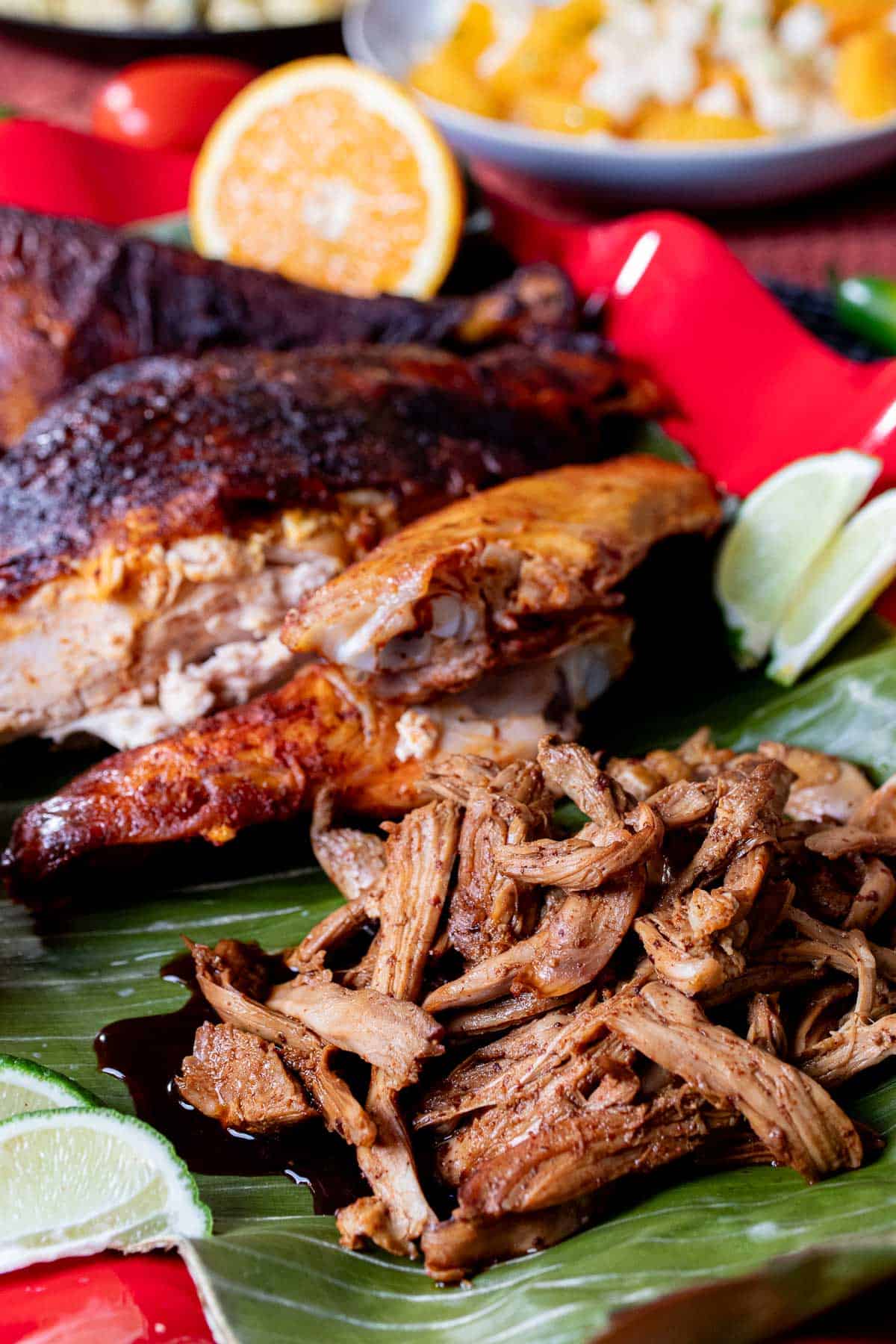
Achiote paste is the heart of the marinade, giving the roasted turkey its earthy and slightly peppery flavor, as well as the color. The rest of the flavor comes from citrus like bitter Seville oranges, or a mixture of regular oranges, lime, and/or grapefruit. Seasonings and spices like oregano, cumin, cinnamon, clove, and black pepper round out the rest of the warming flavors.
Jump to:
🥘 Ingredients for Yucatan Roasted Turkey
The ingredients for this roasted turkey include a marinade and what you need for the turkey. While I don’t recommend making a gravy from the marinade and drippings, I do find they make a great sauce to optionally mix the turkey with after cooking.
Marinade
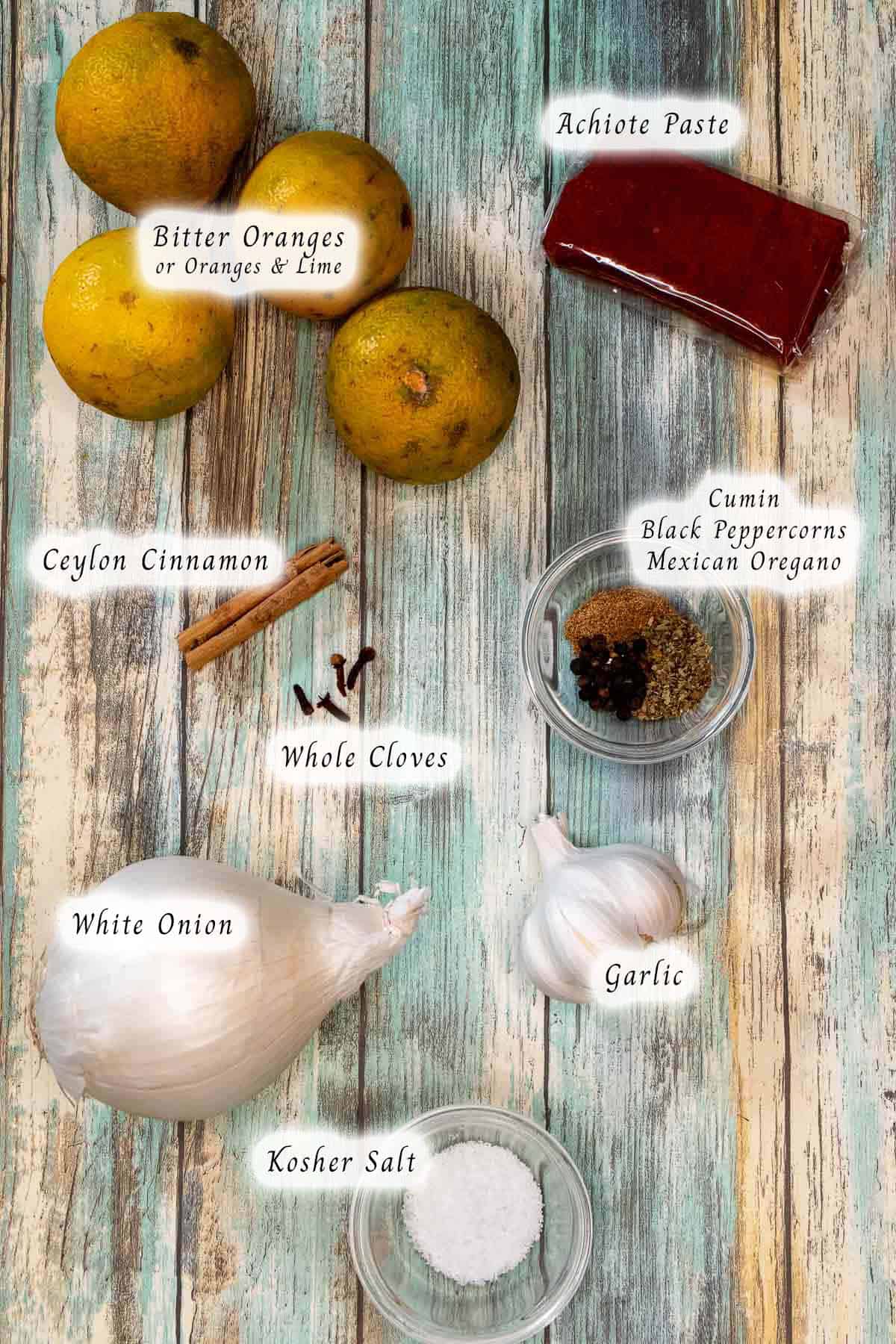
Achiote – The main star in pibil recipes is achiote paste, giving the earthy and peppery flavor as well as the coloring. This paste is made from ground annatto seeds and can be found in most international and Latin stores.
Citrus – The next main ingredient is citrus juice. Usually made from bitter Seville oranges commonly found in the Yucatan peninsula, these can be more difficult to find elsewhere. A common substitute is a mixture of orange juice with lime and/or grapefruit juices.
Spices – I use a spice blend of Mexican oregano, black peppercorns, cumin seeds (or powder), whole cloves, and a piece of a (Ceylon) cinnamon stick, also known as canela.
Vegetables – To round out the marinade, use some white onion and a generous amount of garlic.
Turkey
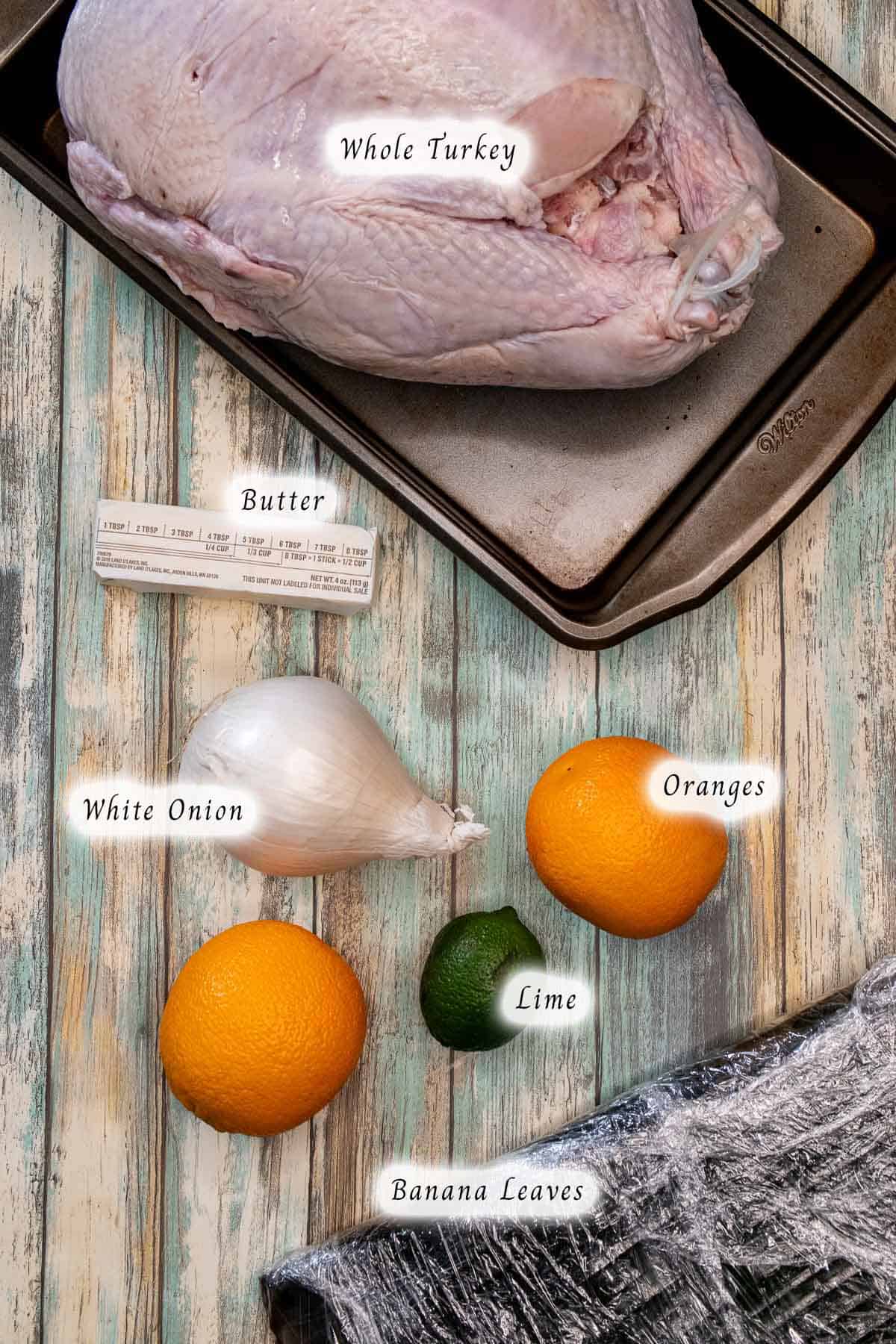
Turkey – Use a whole turkey here, between 10-14-pounds. A smaller or larger bird may need adjustments in the rest of the ingredients.
Butter – I use a whole stick of butter, but you could use more if preferred.
Citrus & Vegetables – Here I use a bit of orange, lime, and white onion to stuff the bird with for added flavor and moisture inside the cavity.
Banana Leaves – Easier to find these days, you can usually get a 1-pound package of frozen banana leaves in the freezer section by the Hispanic stuff. I only needed about half the package. Use these, thawed, to (optionally) wrap the turkey in whole roasting for a traditional flavor.
🔪 How to Make Pavo Pibil
I like to marinade this turkey for at least 4 hours, and preferably overnight. If you’re going to do this overnight, be sure your turkey is thawed and ready to go at least 1 day before you plan on cooking it. When frozen, allow at least 1 day/5-pounds to thaw your turkey in the refrigerator.
Marinade
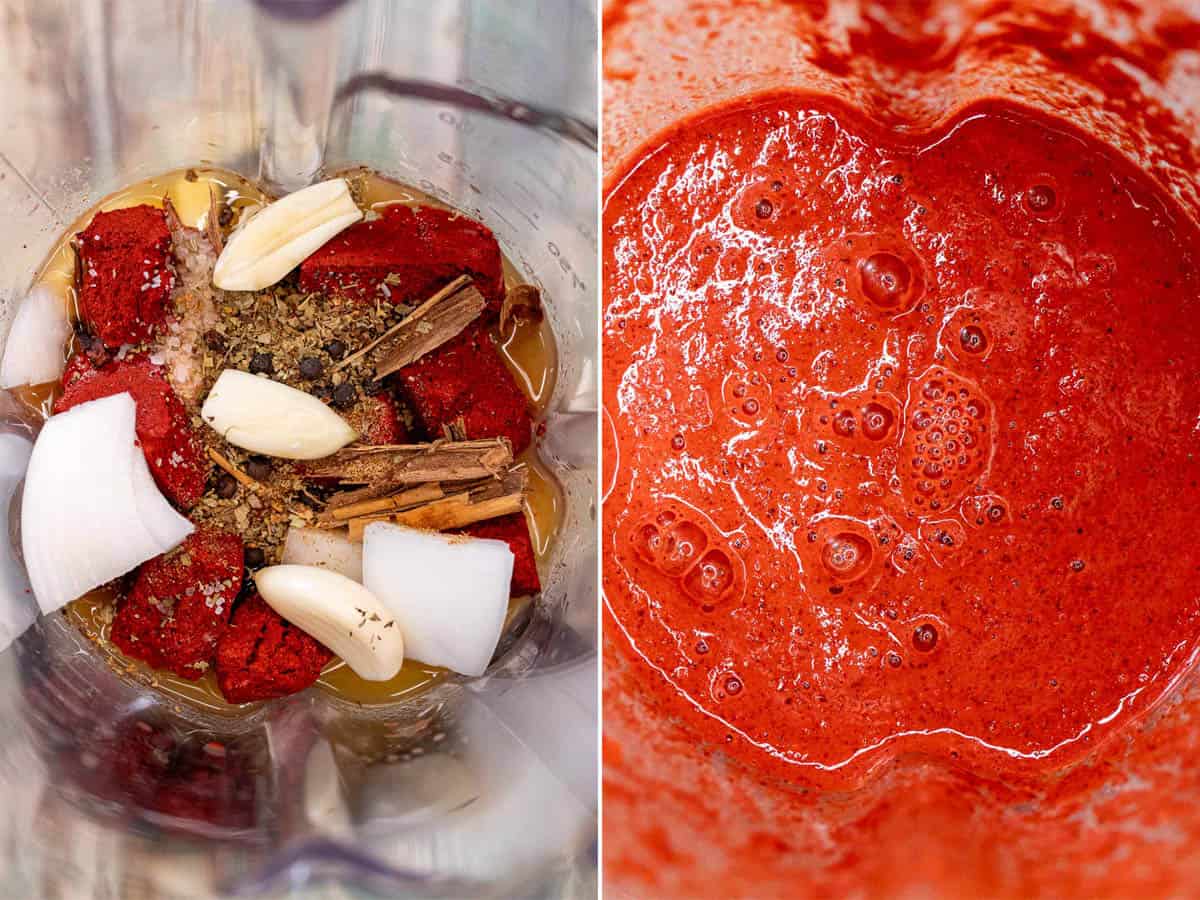
Start by adding all the marinade ingredients into a blender and blending until perfectly smooth. If your blender has trouble getting everything pureed, pour through a fine mesh strainer to remove any remaining pieces of spices.
When completely thawed, remove your turkey from the bag and remove any plastic clamps from the legs and any pieces from inside your turkey like the neck and bags with the heart, giblets, and liver if included. Pat the entire turkey dry with paper towels.
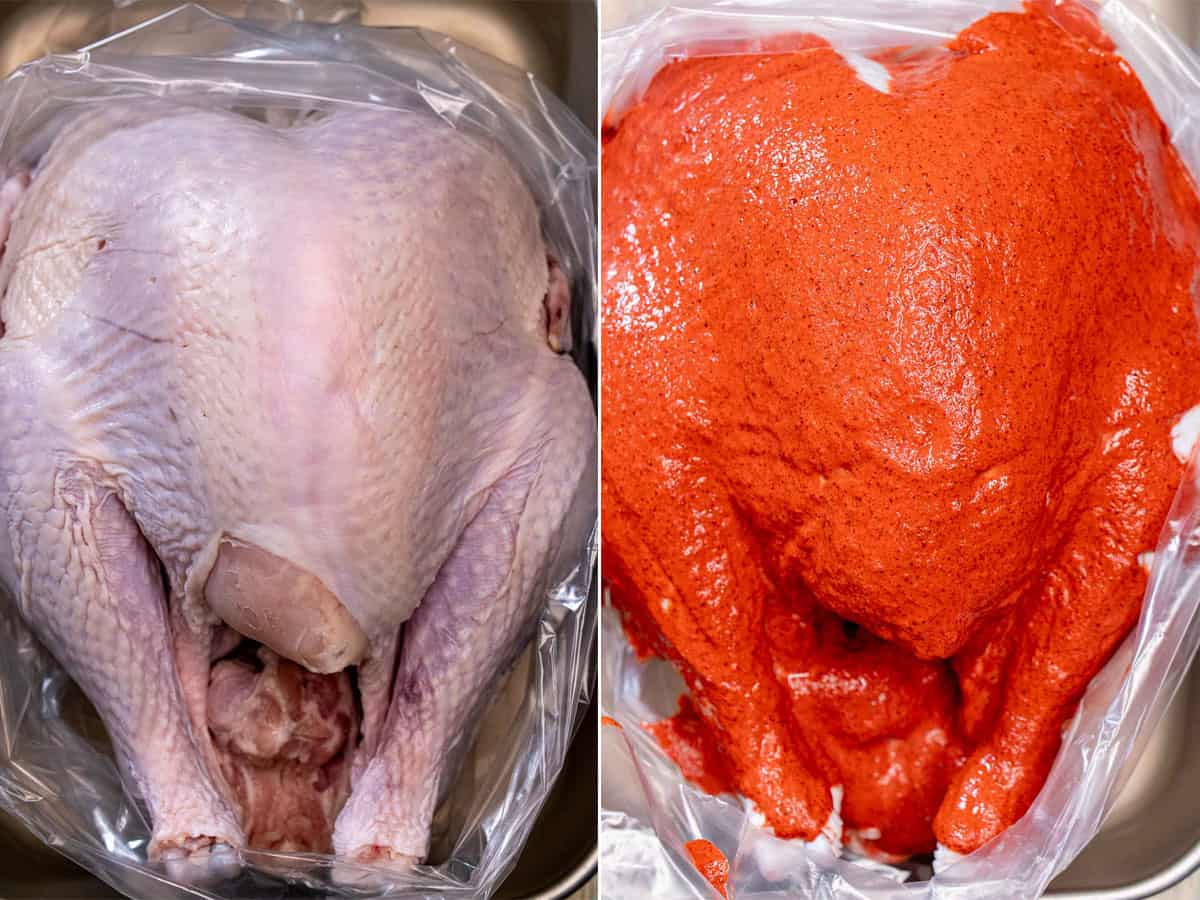
In a large bowl or container, place the turkey breast-side down and pour half the marinade over it. Flip the turkey over and pour the remaining marinade over the rest of turkey, getting it into the cavity and under the skin. I used a turkey oven bag to completely coat the turkey, then sealed it and place it into a roasting pan without a rack.
Set inside your refrigerator and marinade at least 4 hours and preferably overnight. Every few hours, flip the turkey over and massage the marinade around the turkey to maintain coverage.
Preparing the Turkey
Before roasting the turkey, remove it from the refrigerator at least an hour before cooking and begin preheating your oven to 325°F / 160°C, move the rack to the lower ⅓ of the oven, and thaw your banana leaves if using.
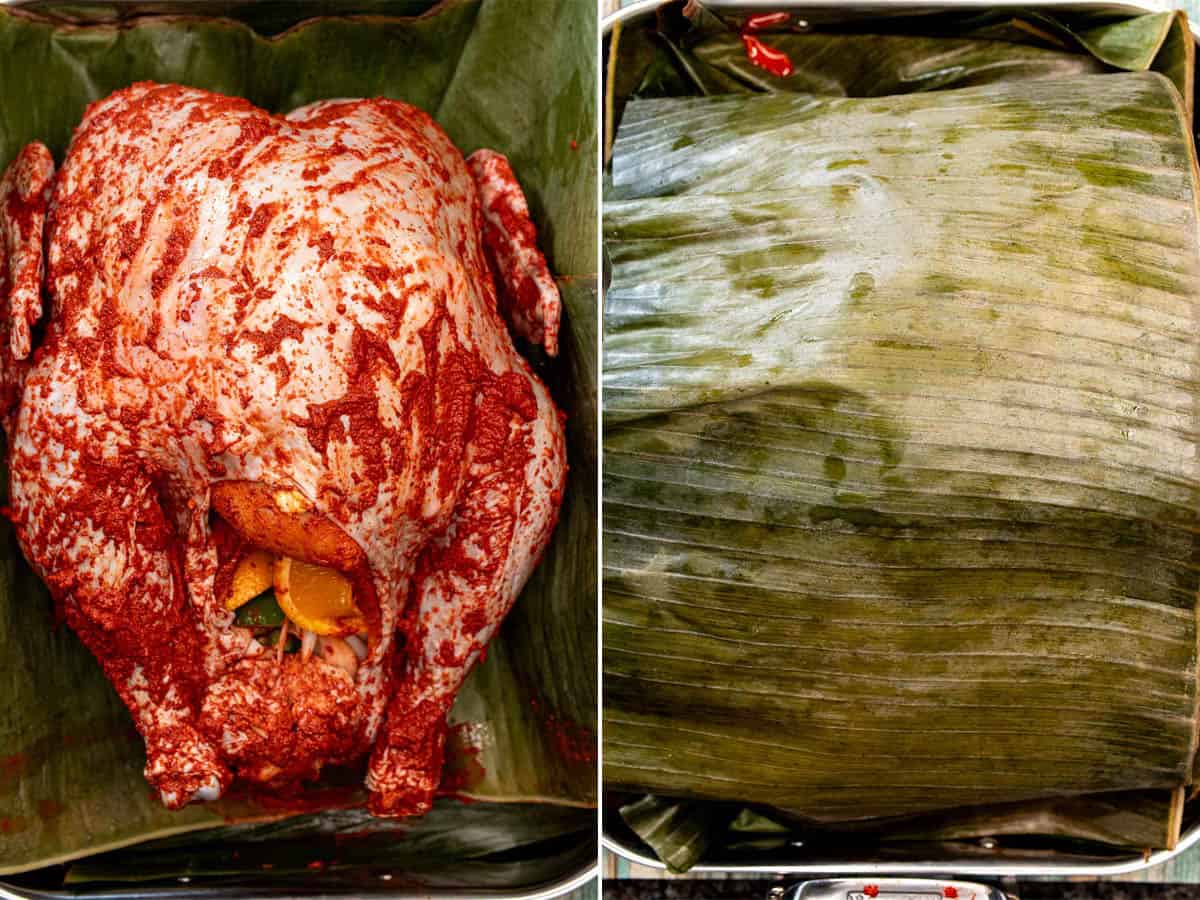
While waiting for the turkey, quarter a lime, some oranges, and white onions. Once thawed, remove the banana leaves and cut into strips. Use 2-3 pieces to line the rack in a roasting pan with enough length that it hangs over the sides. Use a knife to cut numerous slits in the leaves on the rack. This helps improve airflow to the bottom of the turkey and allows drippings to fall and not pool in the leaves.
Remove the turkey from the bag or bowl and place on top of the banana leaves/roasting rack. Cut the butter into ¼-inch pieces and gently loosen the turkey skin around the breasts and legs. Push pieces of butter under the loosened skin as far as you can.
Stuff the lime, orange, and onion wedges into the cavity until filled. Finally, pour the marinade over the turkey, fully covering it. Trim some more banana leaves and wrap the top of the turkey, then loosely cover with some foil. Add a few cups of water or stock to the bottom of the pan to keep the drippings from burning.
Roasting the Turkey
Place the turkey into the oven with the legs facing the back if possible. Bake until fully cooked, basting the turkey every 40ish minutes. Allow for roughly 13-15 minutes/pound and in the last 30ish minutes of cooking you can uncover the top of the turkey to get some better browning.
Never rely on time though, always check the thickest part of the breast and thigh with a quality instant-read thermometer. The breasts should register about 160°F / 71°C and the thighs about 170°F / 77°C. Carry-over cooking will finish cooking the turkey while resting.
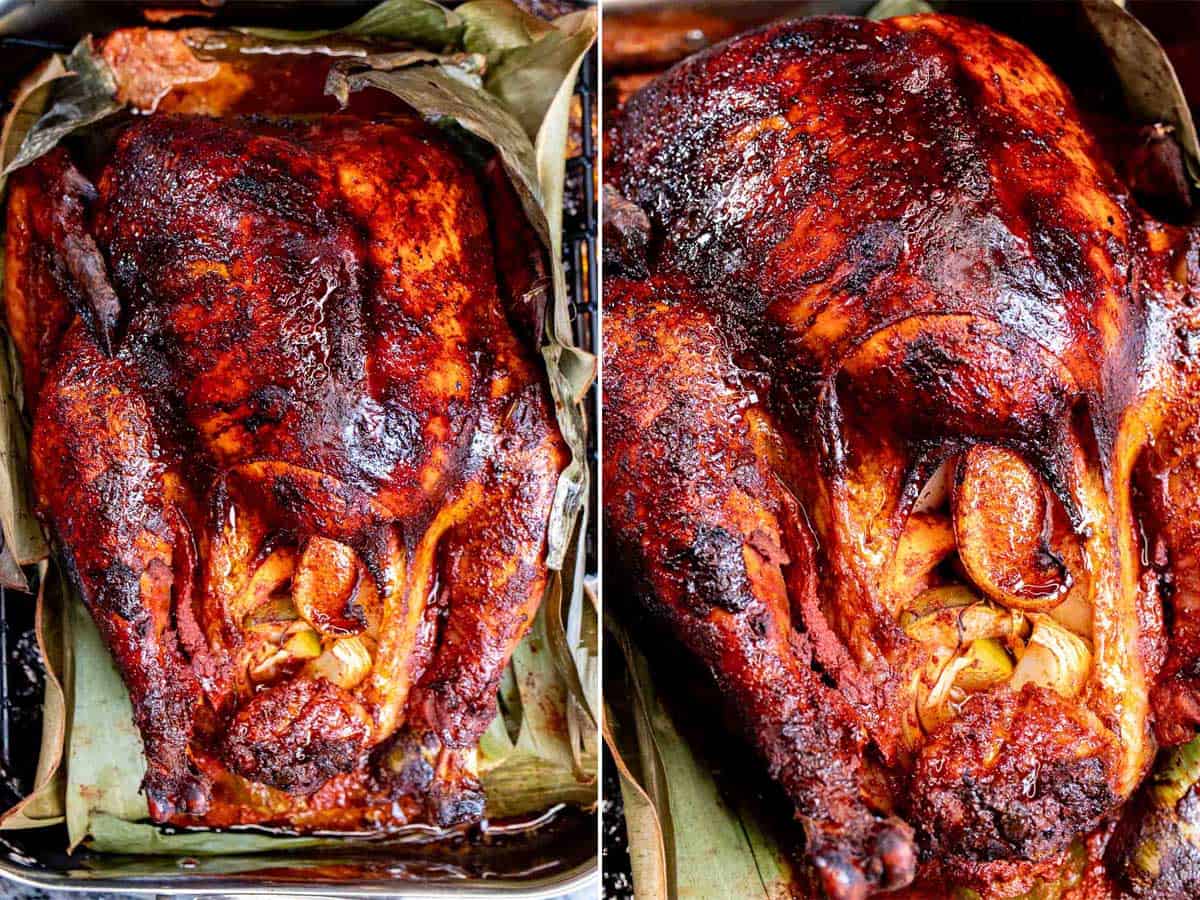
Once the turkey is cooked, remove the rack from the oven and transfer the turkey to a large cutting board or a baking sheet. Cover with foil and allow the bird to rest for at least 30 minutes before carving.
While the turkey rests you can turn the drippings into a sauce as well. If your roasting pan can be used on the stove, place it over a burner on medium heat. If the liquid is low, you can add a cup or so of water or stock and bring to a low simmer. Use a spatula to gently push the liquid around and scrape up any fond (the stuck-on bits in the pan) until you get them all.
Pour the liquid through a fine mesh strainer and skim off any obvious fat. Save this liquid and you can pour it over sliced/pulled turkey or cook leftovers in it.
📜 USDA Thawing & Cooking Guidelines
Thawing Frozen Turkeys
In the Refrigerator (40°F or below)
Allow approximately 24 hours for every 4 to 5 pounds
| 4 to 12 pounds | 1 to 3 days |
| 12 to 16 pounds | 3 to 4 days |
| 16 to 20 pounds | 4 to 5 days |
| 20 to 24 pounds | 5 to 6 days |
Keep the turkey in its original wrapper. Place it on a tray or in a pan to catch any juices that may leak. A thawed turkey can remain in the refrigerator for 1 to 2 days. If necessary, a turkey that has been properly thawed in the refrigerator may be refrozen.
In Cold Water
Allow approximately 30 minutes per pound
| 4 to 12 pounds | 2 to 6 hours |
| 12 to 16 pounds | 6 to 8 hours |
| 16 to 20 pounds | 8 to 10 hours |
| 20 to 24 pounds | 10 to 12 hours |
Wrap your turkey securely, making sure the water is not able to leak through the wrapping. Submerge your wrapped turkey in cold tap water. Change the water every 30 minutes. Cook the turkey immediately after it is thawed. Do not refreeze.
Approximate Times for Oven Roasting
(325°F oven temperature)
Use the timetables below to determine how long to cook your turkey. These times are approximate. Always use a food thermometer to check the internal temperature of your turkey and stuffing.
Unstuffed
| 4 to 8 pounds (breast) | 1½ to 3¼ hours |
| 8 to 12 pounds | 2¾ to 3 hours |
| 12 to 14 pounds | 3 to 3¾ hours |
| 14 to 18 pounds | 3¾ to 4¼ hours |
| 18 to 20 pounds | 4¼ to 4½ hours |
| 20 to 24 pounds | 4½ to 5 hours |
Stuffed
| 4 to 6 pounds (breast) | Not usually applicable |
| 6 to 8 pounds (breast) | 2½ to 3½ hours |
| 8 to 12 pounds | 3 to 3½ hours |
| 12 to 14 pounds | 3½ to 4 hours |
| 14 to 18 pounds | 4 to 4¼ hours |
| 18 to 20 pounds | 4¼ to 4¾ hours |
| 20 to 24 pounds | 4¾ to 5¼ hours |
Personal Advice
Cooking times can vary a lot, especially with two different temperatures. An overly general approximation can vary from 13-18 minutes per pound. I would use a general time of 12-13 minutes per pound to guess when to start checking the temperature of your turkey. It probably won’t be done, but this gives you a good time to start checking instead of opening and closing the oven every 20 minutes.
Always, always rely on a quality instant-read thermometer instead of timetables. Approximate times are great for giving you an idea of how much time to set aside and can help you gauge when to start the cooking if you want to eat at a certain time. However, always confirm the doneness with a thermometer. Waiting for the turkey to rest and then carving it in front of your family isn’t the time to find out that it’s still raw in places.
When checking the temperature, stick the probe of your thermometer in the deepest parts of the breasts, and then check the fat part of drumsticks and thicker parts of the thigh. Try to avoid hitting the bones. If you cook your turkey with stuffing, check that it is cooked to 165°F as well.
🦃 General Oven Roasted Turkey Tips
Buying & Serving Tips
How much turkey?
A good rule of thumb is to plan for 1-1 ¼ pounds per person. Most people aren’t going to actually eat an entire pound of turkey meat, but you’re accounting for the bones and cartilage and other parts that aren’t going to be eaten.
When to buy?
If purchasing a fresh turkey, don’t buy more than 1-2 days ahead of time. Frozen turkeys will need an average of 24 hours per 5 pounds to thaw, so plan ahead. I like to start looking for turkeys 1-3 weeks before Thanksgiving, as that is when you start seeing sales between $0.79 - 0.99/pound.
Serving a small crowd.
Personally, I still like to buy a 10-12lb turkey for a small crowd, because I like making creative leftovers. If you get a good price on a whole turkey, it can also end up cheaper than buying a turkey breast instead.
If the price doesn’t make a big difference to you, then turkey breasts are a good option for a smaller group though. They cook faster and are easier to handle, but you’re also limited to all white meat. Another good option to consider are Cornish hens. Those actually make a nice meal, and you can buy and cook 1 hen for every 1-2 people.
Serving a large crowd.
Trying to find a roasting pan large enough to accommodate a 20-25lb turkey and getting it to cook evenly can be daunting. I’m not a fan of roasting turkeys of that size. They’re difficult to cook evenly, take a long time to bake, and you’re much more likely to dry it out unintentionally.
If you’re serving a huge crowd, there’s two options I suggest. Buy two smaller turkeys and you can spatchcock them. This will allow you to cook them at the same time. Another option is to use a large bird, or two smaller ones, and break them down before cooking. Roasting the turkey in pieces will keep them moist and they cook up much quicker this way.
These options won’t give you a pretty centerpiece for carving, but it beats a pretty bird that’s dried out and takes over 5 hours to cook.
Pre & Post Roasting Tips
Should you brine your turkey?
I have no problem with brining turkeys, and I think both a wet and dry brine has merits. I simply don’t include it with most of my turkey recipes because not everyone has the time or fridge space to do this step. While you can technically make a wet brine outside of the fridge, this process is a lot of work as you must frequently drain and replace the ice to keep the bird cold enough to be safe to eat the next day.
If you have the extra space, feel free to brine your turkey. A wet brine helps to add flavor and keep the turkey moist when it cooks, but can make it harder to get good, crispy skin. Dry brines keep the skin nice and crispy but tend to take longer to do their thing than a wet brine.
Soft Butter.
When using butter on a turkey, it needs to be super soft and not just room temperature. The turkey also needs to sit out for a bit so that it’s not ice cold. Once the butter hits an ice-cold turkey, it seizes up immediately and makes it difficult if not impossible to spread.
Don’t dry out your turkey. People swear by basting their turkey as it cooks, and it’s a popular thing to do. Unfortunately, basting is also self-defeating. It should be keeping the turkey moist in the hot oven by pouring the cooked drippings and hot liquid over the turkey. In reality, the frequent opening and closing of the oven door can drastically lower the oven temperature, causing the turkey to take longer to cook, which ends up drying it out more than skipping the basting.
Cooking stuffing inside the turkey.
I’ve never personally been a fan of doing this. Some people swear by it for the added flavor and keeping the turkey moist from the inside. The drippings also flavor the stuffing. The downside is that there are a lot of health risks involved in cooking the stuffing this way. From the type of stuffing to when it was made to when and how to stuff the turkey, everything can make a difference. Stuff your bird at your own risk and know how to do it properly.
Two Temperature Roasting.
While you can cook the turkey at a temperature of 325°F or 350°F the entire time, I like starting mine at a much higher temperature. I find this method helps to dry out and crisp up the skin and gives the turkey a jumpstart to the cooking process. This usually shaves off a decent amount of time from the total time needed. However, I find this works best with butter basted turkey recipes and not as well on dry rubbed turkeys, as they lack the extra moisture necessary for that initial blast of heat.
Use a thermometer.
I repeat this often because it’s important. Do NOT rely on cooking times. Every oven is different or might be off, and no two turkeys will cook at exactly the same rate. Other details like brining, basting, using liquid in the roasting pan, how often someone opens the door to check on the turkey can all make a difference in the total cook time. Use a quality instant-read thermometer to know for certain when the turkey is done.
Let it rest.
After you remove the turkey from the oven, resist the urge to start carving into it. At the minimum, I suggest letting it rest for at least 15-20 minutes. If you can wait, push that to 35-45 minutes. Letting it rest allows all the juices inside the meat to redistribute and the muscles to relax. Carving too early can lead to dry turkey. Tent with foil to keep it warm and use the time to finish cooking and arranging other dishes.
🥗 How to Serve & What to Serve with Yucatan Turkey
How to Serve
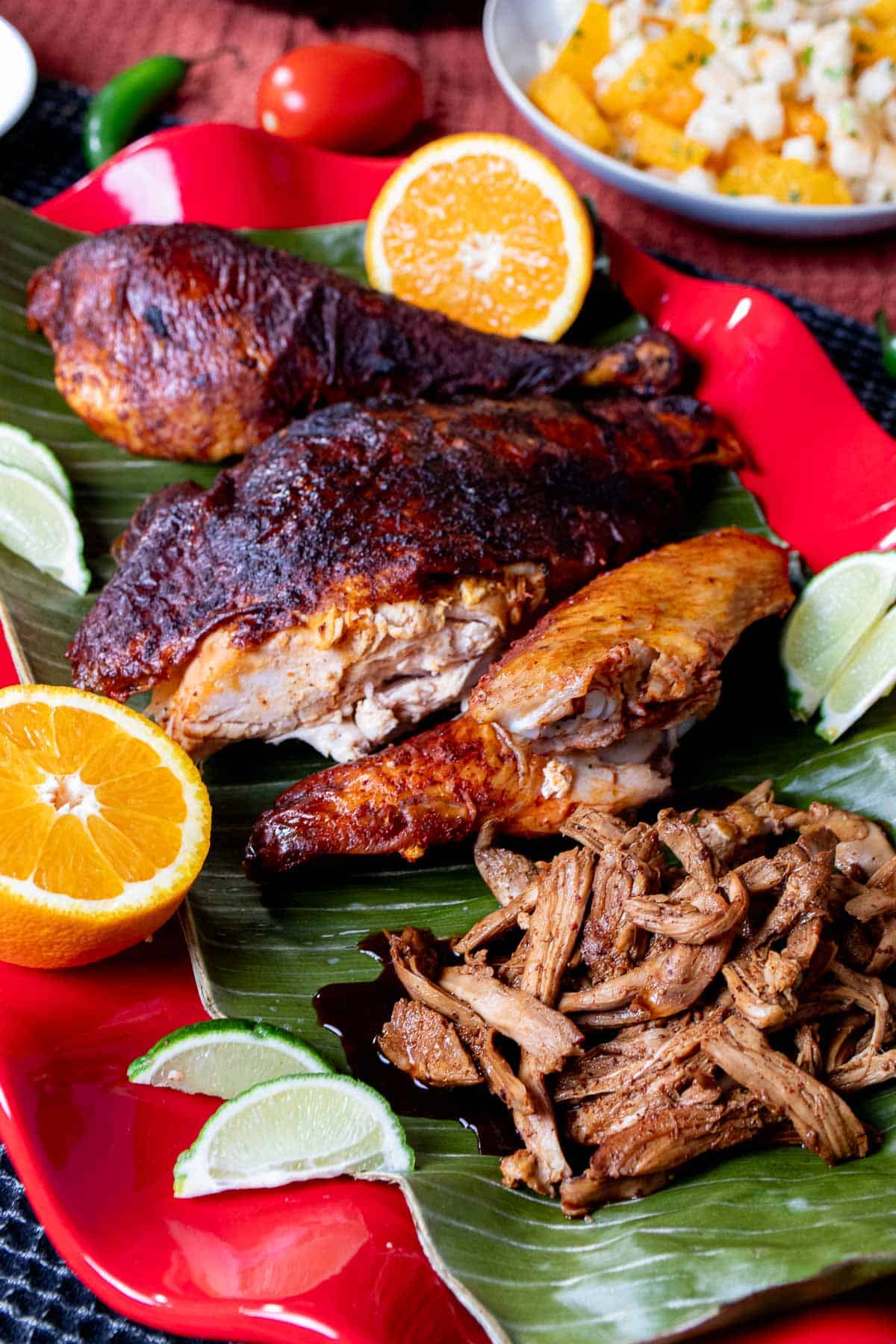
There are multiple ways you can serve pavo pibil. Like in my photos, you can serve this simply carved like an American Thanksgiving turkey or shred the meat and turn it into other dishes. I like to save the marinade and turkey drippings from the roasting pan, add some water or stock, bring to a simmer and scrape up the fond and reduce the liquid a bit.
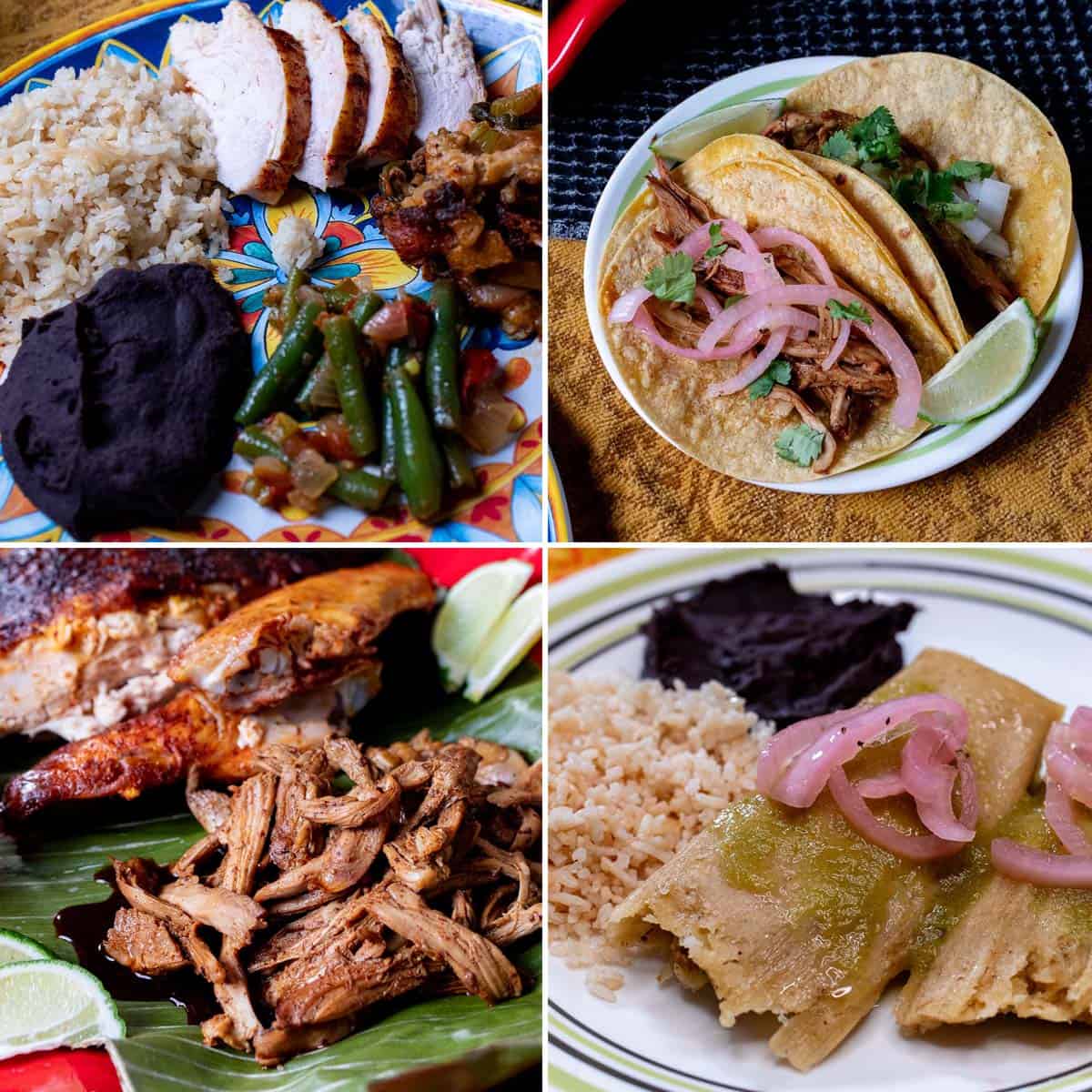
I actually left the thighs slightly undercooked, removed the bone, and hand pulled the turkey. Heat a pan with some lard or oil and fry the meat in there and add some of that reduced marinade/drippings to finish cooking the turkey in that.
You can serve the turkey like that, or turn it into things like panuchos, tacos, or quesadillas. With the leftover turkey, I shredded it with more of that juice and made a big batch of turkey tamales.
What to Serve
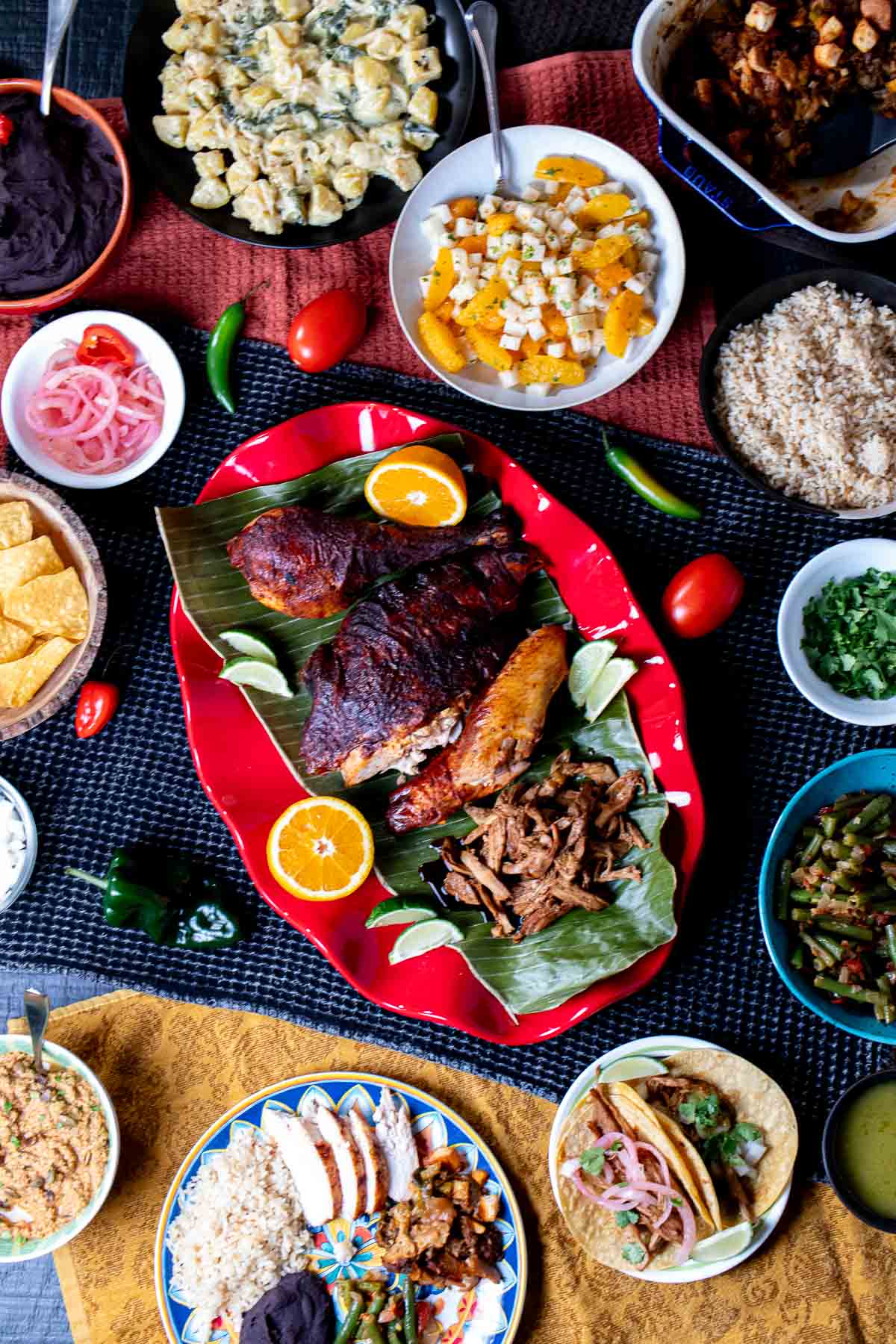
As seen in the big spread photo, I served this Yucatan-style roasted turkey with numerous popular Yucatan/Mayan side dishes and condiments, as well as with other Mexican and Mexican-inspired dishes.
In the picture I served this alongside recipes such as:
- Fried Black Beans – Frijoles Colada
- Creamy Poblano Potatoes – Papas y Rajas con Crema
- Pumpkin Seed Dip – Sikil Pak
- Yellow Rice – Arros Amarillo
- Pickled Red Onions – Escabeche de Cebolla
- Jicama Citrus Salad – Xe’ec
- Mexican Green Beans – Ejotes a la Mexicana
- Chorizo and Poblano Stuffing
- Pumpkin Tres Leche
🍽 Recommended Equipment
If you’re roasting a turkey in your oven, whether it’s this Cajun roasted turkey or any other recipe, you probably already have what you think you’ll need. This list just has a few items I recommend from personal use.
Roasting Pan – A good quality roasting pan can make a difference. These things come in multiple sizes, prices, and differently shaped racks. I like this All-Clad 13x9 Roaster Pan because of the shape of the rack, the large handles for safe gripping, and ability to withstand oven temperatures up to 500°F.
Roast Lifters – These roast lifters are great for moving around large turkeys and beef or pork roasts. They’re great for moving hot and heavy large pieces of meat around without burning yourself.
Instant-Read Thermometer – As I mention repeatedly, a quality instant-read thermometer is the only thing you should rely on for determining when the turkey is done. This ThermoWorks Thermapen Instant-Read Thermometer is a bit of an investment but is so highly rated for good reason. I’ve been using mine for years without fail, on everything from turkeys to roasts to pork shoulders and loins, steaks, burgers, breads, and even fry oil temperature. It gives you an accurate reading in about 1 second, so that you can quickly check the temperature and shut the oven door again.
❄️ How to Store Pavo Pibil
Cooled turkey shouldn’t sit out at room temperature for more than 2 hours. Once everyone has had their fill from the feast, the rest of the turkey should be carved into manageable pieces and stored.
Once broken down, transfer the leftover turkey to an airtight container or distribute it into plastic bags and refrigerate for 3-4 days. If you wish to store leftover Yucatan roasted turkey longer than that, you can freeze it for 3-6 months instead.
You can make homemade turkey stock with the remains of the carcass and any other bones by breaking down the carcass and transferring all the pieces to freezer safe bags and freezing them for up to 6 months. If you plan to make stock that day or the next, you can refrigerate them instead.
When you wish to reheat the leftover turkey, you have two options. For a small amount, you can microwave leftovers at 50% power a minute at a time until heated throughout and brought to 165°F. The best method, however, would be to place the turkey in a baking dish and reheat in a 350°F oven. Add a splash of stock or butter to the baking dish to keep the turkey moist and cover the dish. Reheat until it registers 165°F as well.
📋 Recipe
Yucatan Roasted Turkey
Ingredients
Achiote Marinade:
- 3 ½ ounce achiote paste, see note
- 1 cup bitter orange juice, or ½ cup each orange/lime juice
- 1 teaspoon Mexican oregano
- ½ teaspoon cumin seeds, or ground cumin
- 4 whole cloves
- ¾ teaspoon black peppercorns
- ¼ stick panela, Ceylon cinnamon
- 8 cloves garlic
- ½ medium white onion, roughly chopped
- 2 teaspoons kosher salt
Turkey:
- 10-14 pound turkey, thawed
- 1 stick butter
- 2 medium oranges, quartered
- 1 medium lime, quartered
- 1 medium white onion, quartered
- 1 pound banana leaves, optional
Directions
- I like to marinade this turkey for at least 4 hours, and preferably overnight. If you’re going to do this overnight, be sure your turkey is thawed and ready to go at least 1 day before you plan on cooking it. When frozen, allow at least 1 day/5-pounds to thaw your turkey in the refrigerator.
Marinade:
- Start by adding all the marinade ingredients into a blender and blending until perfectly smooth. If your blender has trouble getting everything pureed, pour through a fine mesh strainer to remove any remaining pieces of spices.
- When completely thawed, remove your turkey from the bag and remove any plastic clamps from the legs and any pieces from inside your turkey like the neck and bags with the heart, giblets, and liver if included. Pat the entire turkey dry with paper towels.
- In a large bowl or container, place the turkey breast-side down and pour half the marinade over it. Flip the turkey over and pour the remaining marinade over the rest of turkey, getting it into the cavity and under the skin. I used a turkey oven bag to completely coat the turkey, then sealed it and place it into a roasting pan without a rack.
- Set inside your refrigerator and marinade at least 4 hours and preferably overnight. Every few hours, flip the turkey over and massage the marinade around the turkey to maintain coverage.
Preparing the Turkey:
- Before roasting the turkey, remove it from the refrigerator at least an hour before cooking and begin preheating your oven to 325°F / 160°C, move the rack to the lower ⅓ of the oven, and thaw your banana leaves if using.
- While waiting for the turkey, quarter 2 oranges, 1 lime, and 1 medium white onion. Once thawed, remove the banana leaves and cut into strips. Use 2-3 pieces to line the rack in a roasting pan with enough length that it hangs over the sides. Use a knife to cut numerous slits in the leaves on the rack. This helps improve airflow to the bottom of the turkey and allows drippings to fall and not pool in the leaves.
- Remove the turkey from the bag or bowl and place on top of the banana leaves/roasting rack. Cut 1 stick of butter into ¼-inch pieces and gently loosen the turkey skin around the breasts and legs. Push pieces of butter under the loosened skin as far as you can.
- Stuff the orange, lime, and onion wedges into the cavity until filled. Finally, pour the marinade over the turkey, fully covering it. Trim some more banana leaves and wrap the top of the turkey, then loosely cover with some foil. Add 2-3 cups of water or stock to the bottom of the pan to keep the drippings from burning.
Roasting the Turkey:
- Place the turkey into the oven with the legs facing the back if possible. Bake until fully cooked, basting the turkey every 40ish minutes. Allow for roughly 13-15 minutes/pound and in the last 30ish minutes of cooking you can uncover the top of the turkey to get some better browning.
- Never rely on time though, always check the thickest part of the breast and thigh with a quality instant-read thermometer. The breasts should register about 160°F / 71°C and the thighs about 170°F / 77°C. Carry-over cooking will finish cooking the turkey while resting.
- Once the turkey is cooked, remove the rack from the oven and transfer the turkey to a large cutting board or a baking sheet. Cover with foil and allow the bird to rest for at least 30 minutes before carving.
- While the turkey rests you can turn the drippings into a sauce as well. If your roasting pan can be used on the stove, place it over a burner on medium heat. If the liquid is low, you can add a cup or so of water or stock and bring to a low simmer. Use a spatula to gently push the liquid around and scrape up any fond (the stuck-on bits in the pan) until you get them all.
- Pour the liquid through a fine mesh strainer and skim off any obvious fat. Save this liquid and you can pour it over sliced/pulled turkey or cook leftovers in it.
Comments
No Comments