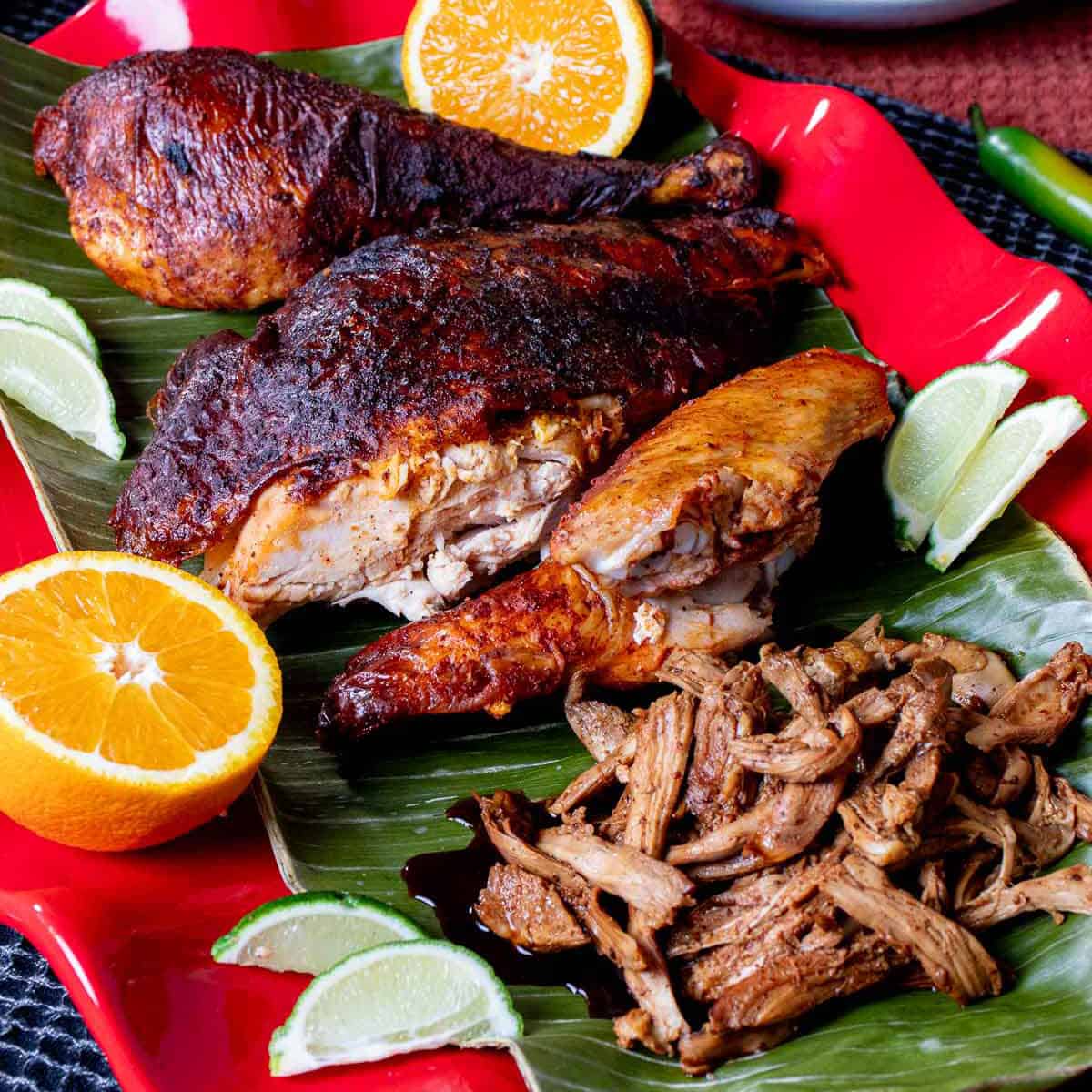
Yucatan Roasted Turkey
This Yucatan roasted turkey, or pavo pibil, is a flavorful spin on traditional oven roasted whole turkeys. Mimicking traditional Mayan flavors, this turkey comes out earthy, citrusy, and slightly peppery.
Ingredients
Achiote Marinade:
- 3 ½ ounce achiote paste, see note
- 1 cup bitter orange juice, or ½ cup each orange/lime juice
- 1 teaspoon Mexican oregano
- ½ teaspoon cumin seeds, or ground cumin
- 4 whole cloves
- ¾ teaspoon black peppercorns
- ¼ stick panela, Ceylon cinnamon
- 8 cloves garlic
- ½ medium white onion, roughly chopped
- 2 teaspoons kosher salt
Turkey:
- 10-14 pound turkey, thawed
- 1 stick butter
- 2 medium oranges, quartered
- 1 medium lime, quartered
- 1 medium white onion, quartered
- 1 pound banana leaves, optional
Directions
- I like to marinade this turkey for at least 4 hours, and preferably overnight. If you’re going to do this overnight, be sure your turkey is thawed and ready to go at least 1 day before you plan on cooking it. When frozen, allow at least 1 day/5-pounds to thaw your turkey in the refrigerator.
Marinade:
- Start by adding all the marinade ingredients into a blender and blending until perfectly smooth. If your blender has trouble getting everything pureed, pour through a fine mesh strainer to remove any remaining pieces of spices.
- When completely thawed, remove your turkey from the bag and remove any plastic clamps from the legs and any pieces from inside your turkey like the neck and bags with the heart, giblets, and liver if included. Pat the entire turkey dry with paper towels.
- In a large bowl or container, place the turkey breast-side down and pour half the marinade over it. Flip the turkey over and pour the remaining marinade over the rest of turkey, getting it into the cavity and under the skin. I used a turkey oven bag to completely coat the turkey, then sealed it and place it into a roasting pan without a rack.
- Set inside your refrigerator and marinade at least 4 hours and preferably overnight. Every few hours, flip the turkey over and massage the marinade around the turkey to maintain coverage.
Preparing the Turkey:
- Before roasting the turkey, remove it from the refrigerator at least an hour before cooking and begin preheating your oven to 325°F / 160°C, move the rack to the lower ⅓ of the oven, and thaw your banana leaves if using.
- While waiting for the turkey, quarter 2 oranges, 1 lime, and 1 medium white onion. Once thawed, remove the banana leaves and cut into strips. Use 2-3 pieces to line the rack in a roasting pan with enough length that it hangs over the sides. Use a knife to cut numerous slits in the leaves on the rack. This helps improve airflow to the bottom of the turkey and allows drippings to fall and not pool in the leaves.
- Remove the turkey from the bag or bowl and place on top of the banana leaves/roasting rack. Cut 1 stick of butter into ¼-inch pieces and gently loosen the turkey skin around the breasts and legs. Push pieces of butter under the loosened skin as far as you can.
- Stuff the orange, lime, and onion wedges into the cavity until filled. Finally, pour the marinade over the turkey, fully covering it. Trim some more banana leaves and wrap the top of the turkey, then loosely cover with some foil. Add 2-3 cups of water or stock to the bottom of the pan to keep the drippings from burning.
Roasting the Turkey:
- Place the turkey into the oven with the legs facing the back if possible. Bake until fully cooked, basting the turkey every 40ish minutes. Allow for roughly 13-15 minutes/pound and in the last 30ish minutes of cooking you can uncover the top of the turkey to get some better browning.
- Never rely on time though, always check the thickest part of the breast and thigh with a quality instant-read thermometer. The breasts should register about 160°F / 71°C and the thighs about 170°F / 77°C. Carry-over cooking will finish cooking the turkey while resting.
- Once the turkey is cooked, remove the rack from the oven and transfer the turkey to a large cutting board or a baking sheet. Cover with foil and allow the bird to rest for at least 30 minutes before carving.
- While the turkey rests you can turn the drippings into a sauce as well. If your roasting pan can be used on the stove, place it over a burner on medium heat. If the liquid is low, you can add a cup or so of water or stock and bring to a low simmer. Use a spatula to gently push the liquid around and scrape up any fond (the stuck-on bits in the pan) until you get them all.
- Pour the liquid through a fine mesh strainer and skim off any obvious fat. Save this liquid and you can pour it over sliced/pulled turkey or cook leftovers in it.
Equipment Used
Notes
1) Achiote Paste – This is a popular Mexican condiment easily found in most international or Latin stores and is made from ground annatto seeds. If you can’t find it locally, you can also purchase it online.
2) Bitter Orange – While these bitter/sour Seville oranges can be found across Mexico, especially in the Yucatan, they can be harder to find in the US. I can sometimes find these at my grocery store nearby, but international and Latin stores are your best bet.
A common substitute, however, is to mix juices from regular oranges with some lime and/or grapefruit juice.
3) Mexican Ingredients – Mexican oregano is different from Mediterranean oregano. This can be found easily online or in international markets, as well as the panela. Panela cinnamon is the same as Ceylon cinnamon, which is becoming more popular in regular grocery stores, at least ground. If that’s easier to find, that works as well.
4) Banana Leaves – These are traditional for wrapping the meat in recipes like cochinita pibil, but you can leave them out if you like. Easily found in international and Latin stores, they’re becoming more common in chain grocery stores as well, usually in the freezer section where they sell Hispanic goods.
Nutrition
Serving: 10 ouncesCalories: 570kcalCarbohydrates: 6gProtein: 91gFat: 19gSaturated Fat: 9gCholesterol: 296mgSodium: 1144mgPotassium: 1022mgFiber: 1gSugar: 4gCalcium: 67mgIron: 4mg
Tried this recipe?Let us know how it was!
